SLOVAKIA
0 Courses
Golf in Slovakia: Fairways Between the Carpathians and the Danube Shaped by Post-Socialist Renewal
Golf in Slovakia represents a relatively young yet culturally revealing sporting landscape, defined less by aristocratic tradition than by the country’s transition from a centrally planned system to an open European leisure economy.
Unlike Western Europe, Slovakia did not develop golf during the nineteenth or early twentieth centuries, and the sport remained marginal throughout the Czechoslovak socialist era, when land use priorities and limited private leisure infrastructure constrained its growth.
The first true modern golf initiatives began to appear only in the early 1990s following independence, when foreign investors and local entrepreneurs saw golf as both a symbol of international openness and a driver for regional tourism.
Early courses were modest nine-hole layouts, often adapted from agricultural land, but by the early 2000s a more ambitious phase began, introducing championship-length designs and professional course management standards aligned with European Golf Association norms.
This evolution accelerated after Slovakia’s accession to the European Union, as cross-border tourism from Austria, the Czech Republic, and Hungary provided a stable player base.
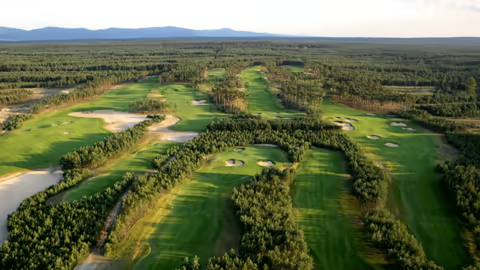
Today, Slovak golf reflects a balance between accessibility and landscape sensitivity, with courses designed to coexist with forests, vineyards, and river plains rather than dominate them.
Regional diversity plays a central role in shaping the Slovak golf experience.
The Bratislava region, positioned along the Danube and near the Austrian border, functions as the country’s golfing gateway, featuring courses that cater to international visitors and business travelers, often characterized by parkland layouts, flat terrain, and strong practice facilities.
Western Slovakia beyond the capital transitions into wine-growing areas where courses integrate gently rolling hills and vineyard vistas, offering strategic play influenced more by contour than length.
Central Slovakia introduces a different identity altogether, as courses are framed by foothills of the Low Tatras, incorporating elevation changes, cooler microclimates, and forest corridors that reward precision over power.
Eastern Slovakia remains less developed but increasingly relevant, with emerging courses positioned as part of broader wellness and spa tourism zones, linking golf with thermal baths and mountain resorts.
Signature courses illustrate these regional identities while anchoring Slovakia’s international credibility.
Penati Golf Resort, designed by Nicklaus Design, stands as the most visible example, featuring a championship course with wide fairways balanced by complex green structures and a history of hosting European Tour-sanctioned events and elite amateur championships since the 2010s, maintaining relevance in the post-2020 tournament calendar through international amateur play.
Gray Bear Tále, redesigned by Jonathan Gaunt, exemplifies central Slovak golf, using natural valleys and elevation shifts to create visually enclosed holes and demanding approach shots, while serving as a regular venue for national championships.
Red Oak Golf Club near Nitra, designed by Jonathan Davison, blends open parkland with wooded sections, emphasizing strategic bunkering and accessibility for a wide handicap range, and has become a hub for junior and collegiate competitions.
Black Stork Golf Resort in Veľká Lomnica, set against the High Tatras, highlights Slovakia’s alpine dimension, with mountain backdrops influencing both climate and playability, and a strong focus on resort-based golf tourism rather than professional tournaments.
Player development in Slovakia has progressed steadily since 2020 through structured junior programs supported by the Slovak Golf Association, which has prioritized school outreach, subsidized coaching, and regional training centers.
While Slovakia has yet to produce a sustained presence on the DP World Tour, several players have achieved success on the Pro Golf Tour and other European developmental circuits, benefiting from improved coaching standards and cross-border competition exposure.
Golf tourism remains a growing segment rather than a mass market, appealing particularly to Central European travelers seeking short stays, with peak playing seasons running from May to October due to continental climate constraints.
Packages often combine golf with spa access, cycling routes, and historic towns, such as medieval mining settlements or Danube river cruises near Bratislava.
Sustainability has become increasingly integrated into Slovak golf operations since 2020, driven by EU environmental frameworks and public sensitivity to land use.
Courses increasingly rely on rainwater retention systems, limit irrigation to drought-tolerant turf varieties, and invest in energy-efficient maintenance facilities, while biodiversity initiatives protect deer habitats, bird nesting areas, and native grasslands within course boundaries.
Looking ahead, Slovakia’s golf sector emphasizes consolidation and quality enhancement rather than rapid expansion, with future projects focusing on upgrading existing facilities, attracting more international amateur tournaments, and positioning golf as a complementary element within broader nature-based tourism strategies rather than a standalone luxury product..