PANAMA
1 Courses
Golf in Panama: Canal Crossroads and Tropical Fairways
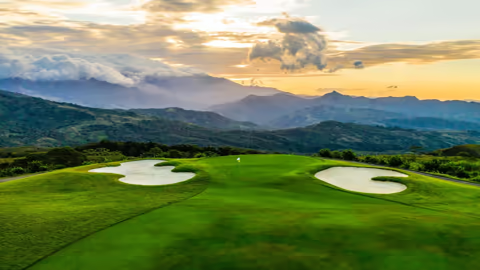
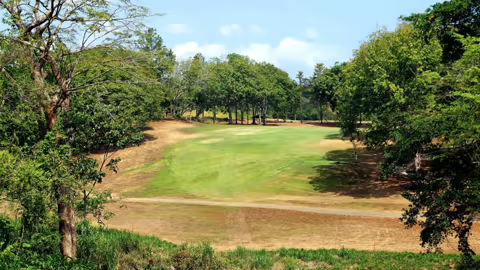
Golf in Panama occupies a distinctive position in the global golf landscape, shaped by the country’s role as a strategic crossroads between oceans, continents, and cultures, and by its unique tropical geography that compresses mountains, rainforests, coastlines, and urban centers into a narrow isthmus.
The historical roots of golf in Panama can be traced to the early twentieth century, when the construction and later administration of the Panama Canal brought a sustained Anglo-American presence that introduced organized leisure activities, including golf, for engineers, military personnel, and administrators.
The earliest courses were modest layouts created near Canal Zone settlements, designed primarily for expatriate communities rather than local participation, and they reflected utilitarian design principles adapted to humid climates and heavy rainfall.
Over the decades following Panamanian sovereignty over the Canal Zone in 1979 and its full transfer in 1999, golf gradually evolved from an expatriate pastime into a broader recreational and tourism-oriented sport, supported by economic growth, real estate development, and increased international visibility.
Today, Panama’s key golf regions demonstrate clear contrasts despite the country’s small size.
The Panama City metropolitan area concentrates the highest number of courses and serves as the administrative and competitive heart of Panamanian golf, where urban density meets coastal wetlands and reclaimed land.
West of the capital, the Pacific Riviera zone around Coronado and Buenaventura offers resort-style golf framed by beaches and tropical forests, emphasizing residential communities and international tourism.
In the central highlands of Chiriquí, near Boquete, cooler temperatures and volcanic soils create an inland golf environment markedly different from the coast, with elevation changes and mountain vistas shaping play.
On the Caribbean side, although golf development is more limited due to conservation priorities and rainfall patterns, boutique projects have emerged that emphasize ecological integration over scale.
Signature courses in Panama illustrate the country’s adaptive approach to design and context.
Santa Maria Golf & Country Club near Panama City, designed by Nicklaus Design, features wide corridors, strategic bunkering, and water management systems engineered to cope with tropical downpours, and it has hosted regional professional events that helped place Panama on the Latin American golf circuit.
The Buenaventura Golf Club, a Jack Nicklaus Signature course on the Pacific coast, combines resort luxury with environmental considerations, routing holes through mangroves, lakes, and preserved forest areas while integrating real estate development, and it has been used for international amateur championships.
Summit Golf Club, located near the former Canal Zone and designed by Jeffrey Myers, reflects a transitional style that blends parkland characteristics with tropical vegetation and serves as an accessible venue for local players and corporate events.
The Club de Golf de Panamá, one of the country’s oldest institutions, carries historical significance and remains central to national competitions, despite ongoing modernization efforts.
Player development in Panama has gained structure since 2020, driven by the Panamanian Golf Federation’s emphasis on youth programs, school partnerships, and regional competition.
Junior academies associated with major clubs provide training that aligns with international rules and etiquette while remaining accessible to a broader socioeconomic base, and post-2020 participation data suggests steady growth in junior licenses, although comprehensive public statistics remain limited.
Notable Panamanian professionals have primarily competed on regional Latin American tours, with several players earning collegiate scholarships in the United States, reflecting a development pathway that combines domestic training with overseas education rather than a fully professional domestic tour.
Tourism appeal is a central pillar of Panamanian golf’s contemporary identity, as the country positions itself as a short-stay, multi-experience destination rather than a pure golf pilgrimage.
Golf packages often combine rounds with canal transits, historical district visits in Casco Viejo, rainforest excursions in Soberanía National Park, and beach stays on the Pacific coast, making golf one element of a diversified itinerary.
Peak golf season aligns with the dry months from December to April, when North American and European travelers seek winter sun, while the shoulder seasons attract regional visitors willing to trade occasional rain for lower rates.
Sustainability efforts have become increasingly prominent since 2020, reflecting both environmental necessity and international expectations.
Courses have invested in water recycling systems, drought-resistant grass varieties suited to tropical climates, and reduced chemical usage to protect surrounding ecosystems, particularly mangroves and wetlands.
Energy efficiency initiatives, including solar installations at club facilities, are gradually expanding, and some resorts pursue international environmental certifications, although adoption remains uneven.
Looking ahead, the future of golf in Panama appears cautiously optimistic rather than expansively ambitious.
Planned projects focus on upgrading existing courses, improving maintenance standards, and enhancing junior development infrastructure rather than building large numbers of new layouts, reflecting land constraints and environmental regulation.
There is ongoing discussion about bidding for more prominent regional tournaments to strengthen Panama’s competitive profile, and growth forecasts emphasize quality, sustainability, and integration with tourism rather than volume, positioning Panamanian golf as a niche experience rooted in its canal-linked history, compact geography, and tropical setting..