LESOTHO
0 Courses
Golf in Lesotho: High-Altitude Fairways in the Mountain Kingdom
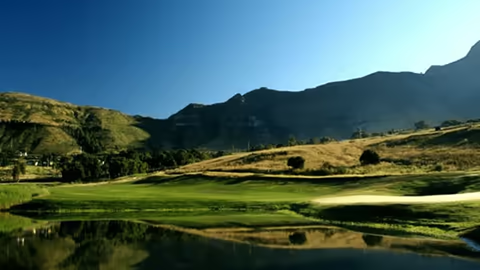
Golf in Lesotho occupies a distinctive niche shaped by altitude, climate, and the country’s layered history as a mountain kingdom surrounded by South Africa, with the game arriving relatively late compared to coastal African nations but evolving in ways closely tied to colonial administration, missionary education, and cross-border sporting exchange.
The historical roots of golf in Lesotho can be traced to the mid-20th century when British administrators and expatriate teachers introduced the game as a recreational activity in Maseru, adapting it to rugged terrain and cooler highland weather that differs markedly from lowland African courses.
Early fairways were often carved from communal land with the consent of local chiefs, embedding golf within Basotho customs of land stewardship rather than private enclosure, and this tradition still influences access and dress etiquette today, where respectful attire and deference to local events such as community gatherings or funerals are expected.
Over time, particularly after independence, golf shifted from an expatriate pastime to a modest but meaningful local sport supported by clubs that double as social institutions.
The key regions for golf reflect Lesotho’s geography, beginning with Maseru and the Caledon River Valley, where lower altitude and proximity to South Africa facilitate year-round play and visiting golfers, followed by the Leribe district in the north, characterized by cooler temperatures and rolling foothills that produce shorter, wind-affected holes, then the Roma Valley near educational institutions where student participation has shaped a more inclusive club culture, and finally the broader highland areas used for informal or seasonal layouts that emphasize walking golf and natural contours rather than intensive landscaping.
Signature courses remain few but distinctive, led by Maseru Golf Club, an 18-hole course whose original routing is attributed to collaborative work by local engineers and expatriate players rather than a single named architect, featuring narrow kikuyu fairways, small elevated greens, and strategic use of river crossings that reward accuracy over power, with club championships and inter-provincial matches forming its competitive backbone since 2020 as earlier records are fragmented.
In the north, Leribe Golf Course, often described in local sporting archives as a community-driven layout, offers fewer formal amenities but a compelling design that uses natural undulation and prevailing winds, with par threes framed by mountain backdrops and a tradition of mixed-ability competitions that encourage junior participation.
A third notable venue is the Roma Valley course area, associated with university sport, where shorter loops and practice grounds support instruction and intervarsity play rather than large tournaments, reflecting an educational emphasis in course design.
Player development in Lesotho is grassroots by necessity, with junior programs linked to schools and youth clubs rather than commercial academies, focusing on fundamentals, etiquette, and fitness suitable for altitude conditions; while Lesotho has yet to produce touring professionals with global recognition, several amateurs have represented the country in regional events since 2020, gaining experience in South African circuits and returning to mentor younger players.
Tourism appeal centers on the novelty of high-altitude golf combined with cultural immersion, with small tour operators offering custom packages that blend morning rounds with afternoon visits to mountain villages, pony trekking, or cultural performances, and peak seasons aligning with the dry, mild months when fairways remain firm and scenic.
Sustainability efforts are pragmatic rather than branded, emphasizing minimal irrigation, reliance on natural rainfall, and coexistence with grazing land, with wildlife such as birds and small antelope treated as part of the playing environment rather than excluded, though formal certifications remain limited as of post-2020 reporting.
Looking ahead, future projects discussed within sporting councils include modest course upgrades, practice facilities, and bids to host regional amateur tournaments to raise standards and visibility, with growth forecasts remaining cautious but optimistic, grounded in youth engagement, cross-border cooperation, and the enduring appeal of golf played against the dramatic landscapes of the Mountain Kingdom..