ESTONIA
0 Courses
Golf in Estonia: Nordic Fairways Framed by Baltic Coasts, Bogs, and Digital-Era Identity
Golf in Estonia occupies a distinctive place within Northern European sport, shaped by a late but deliberate emergence, a strong connection to landscape preservation, and a cultural context influenced by Nordic values and post-Soviet transformation.
Unlike countries where golf arrived through British trade routes in the nineteenth century, Estonia’s first true golf developments appeared only in the 1990s following the restoration of independence, when land reform and foreign investment opened possibilities for leisure infrastructure previously unavailable.
Early initiatives were modest, often driven by expatriate communities and local entrepreneurs inspired by Finnish and Swedish models rather than Central European traditions.
The opening of Niitvälja Golf in the early 1990s marked the foundational moment, establishing a benchmark for course quality and governance and aligning Estonian golf with Scandinavian design philosophies emphasizing natural terrain, firm playing surfaces, and seasonal adaptability.
Throughout the 2000s and into the 2010s, the sport evolved steadily rather than rapidly, with careful planning reflecting Estonia’s broader societal emphasis on sustainability, digital efficiency, and public access to nature.
Post-2020, golf in Estonia has increasingly been positioned as a niche but high-quality outdoor activity compatible with national environmental priorities rather than a mass tourism driver.
Regional differentiation plays a key role in defining Estonian golf.
Northern Estonia, particularly around Tallinn and the Baltic coastline, forms the country’s golfing core, where courses are influenced by limestone soils, coastal winds, and long summer daylight hours that allow extended evening play.
These layouts often resemble coastal parkland rather than true seaside links, blending open horizons with forested edges and requiring strategic control in variable wind conditions.
Western Estonia, including areas near Pärnu and the islands, introduces a more relaxed resort-oriented character, where golf integrates with spa culture, sandy soils, and maritime climates moderated by the sea.
Central Estonia remains lightly developed for golf, reflecting agricultural priorities, but offers opportunities for inland courses emphasizing tranquility and multi-sport tourism.
Southern Estonia, closer to rolling hills and lakes, supports smaller-scale facilities that combine golf with nature tourism, cycling, and winter sports, highlighting the country’s multi-season approach to recreation.
Several signature courses illustrate Estonia’s golfing identity.
Niitvälja Golf, designed initially by Finnish architect Ronald Fream and later refined by European specialists, remains the flagship, featuring two courses that use natural undulations, minimal earthmoving, and firm greens to create strategic challenges and regularly hosting national championships and Baltic regional tournaments after 2020.
Estonian Golf & Country Club, designed by Lassi Pekka Tilander, represents a more contemporary expression, with a championship course laid out along the Gulf of Finland that incorporates stone walls, sea views, and exposure to Baltic winds, and has hosted European Tour–sanctioned events and international amateur competitions in the last decade.
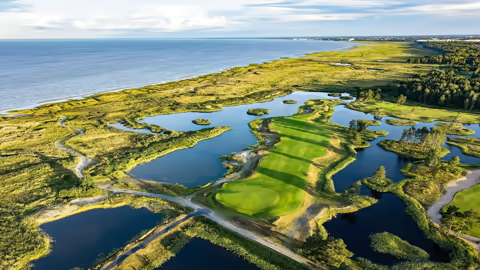
Pärnu Bay Golf Links, by Mick McShane, introduces a true coastal links-inspired concept adapted to local conditions, using sandy soils, fescue grasses, and open horizons to deliver a playing experience rare in the region, gaining recognition through international media and tournament hosting.
Saare Golf on Saaremaa Island offers a contrasting model, smaller in scale and community-focused, integrating golf into island tourism without large resort infrastructure.
Player development in Estonia has advanced gradually, supported by the Estonian Golf Association’s post-2020 focus on junior pathways, school partnerships, and winter training solutions using indoor simulators to offset the short outdoor season.
While Estonia has a limited pool of elite professionals, several players have competed on Nordic Golf League circuits and European amateur championships, benefiting from cross-border competition with Finland and Sweden.
The emphasis remains on broad participation and technical skill development rather than immediate professional success.
Tourism appeal is closely linked to Estonia’s reputation for nature, wellness, and digital convenience.
Golf travel packages typically target visitors from Finland, Sweden, Germany, and increasingly Western Europe, with peak season concentrated between May and September when daylight can extend well into the evening.
These packages often combine golf with medieval Tallinn, coastal spas, national parks, and culinary tourism centered on local produce.
Sustainability has become a defining feature of Estonian golf since 2020, with courses adopting low-input turf management, limiting irrigation through reliance on natural rainfall, and using renewable energy sources where possible.
Wildlife protection is integral, as courses frequently coexist with bird habitats, wetlands, and forest corridors, and environmental certifications are pursued to align with national conservation standards.
Looking ahead, Estonia’s golf sector is expected to grow cautiously, focusing on course upgrades, digital integration for booking and course management, and bids for additional Nordic and Baltic tournaments rather than large-scale new developments, reinforcing golf’s role as a high-quality, environmentally aligned component of Estonia’s outdoor culture..