DOMINICAN-REPUBLIC
2 Courses
Golf in the Dominican Republic: Caribbean Fairways Shaped by Trade Winds, Sugar Estates, and Global Design Heritage
Golf in the Dominican Republic has developed into a distinctive Caribbean expression shaped by geography, tourism-driven investment, and a deliberate embrace of international course architecture rather than a colonial-era sporting tradition.
Unlike countries where golf arrived through British administration, the Dominican Republic’s first modern courses appeared in the 1970s alongside the rise of resort development, particularly on former sugar cane estates and undeveloped coastal land.
Early layouts were designed primarily to support emerging tourism corridors rather than local clubs, but this foundation created an ecosystem that allowed golf to evolve rapidly once global architects became involved in the 1990s and 2000s.
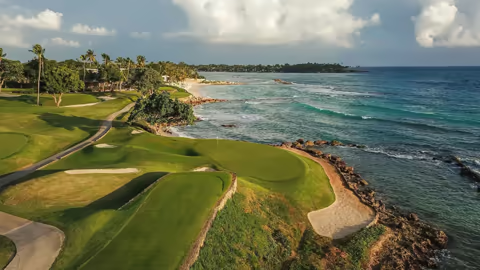
The opening of Casa de Campo’s Teeth of the Dog in the mid-1970s marked a turning point, introducing a rugged seaside aesthetic inspired by wind, coral rock, and ocean exposure that contrasted sharply with inland parkland courses common elsewhere in the Caribbean.
From that moment, the Dominican Republic positioned golf as a premium experiential product aligned with luxury travel, gradually expanding access to local players through academies and hotel-linked practice facilities.
Today, the country’s golf identity is closely tied to its regions, each offering distinct playing conditions.
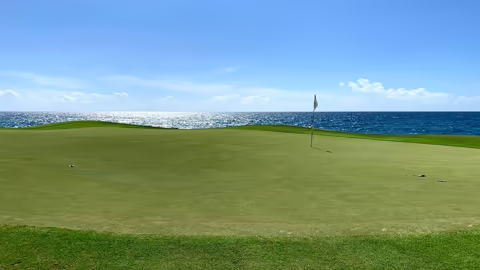
La Romana remains the historic core, where coastal exposure, shallow coral subsoil, and salt-tolerant grasses define play, producing firm fairways and visually dramatic green complexes.
Punta Cana, further east, represents a more contemporary resort model with multiple courses integrated into large-scale hospitality zones, combining inland lagoons with open ocean holes and benefiting from consistent trade winds that influence shot selection year-round.
The Santo Domingo area provides a transitional environment where courses sit closer to urban populations, often flatter and more strategic, supporting local competitions and junior development rather than purely tourist play.
In the north, particularly near Puerto Plata, golf is less dense but increasingly experimental, blending tropical vegetation with mountain backdrops and targeting eco-conscious travelers seeking lower-density resorts.
Signature courses anchor the country’s international reputation, beginning with Teeth of the Dog, designed by Pete Dye, whose use of jagged coral rock edges, forced carries over the Caribbean Sea, and small, contoured greens redefined seaside golf in the region and hosted multiple PGA Tour events, including the Caribbean Classic in recent decades.
Dye’s influence extends to Dye Fore, an elevated inland counterpart overlooking the Chavón River, where dramatic elevation changes and cliff-edge holes contrast with the coastal minimalism of his earlier work.
Punta Espada, designed by Jack Nicklaus, exemplifies a more modern approach with generous landing areas balanced by oceanfront risk-reward holes, having hosted PGA Tour Champions events that reinforced its tournament credentials.
Corales Golf Course, by Tom Fazio, adds a strategic championship dimension with its closing stretch along cliffs and bays, now known internationally through the Corales Puntacana Championship on the PGA Tour, which since 2018 has continued post-2020 as a key spring event.
Playa Grande, redesigned by Robert Trent Jones Sr.
and later refined by his firm, emphasizes expansive scale, wide corridors, and Atlantic winds, showcasing a different coastal character on the island’s north shore.
Player development in the Dominican Republic has historically lagged behind its baseball infrastructure, but post-2020 initiatives have strengthened junior pathways through resort-sponsored academies and partnerships with international instructors.
Programs in Punta Cana and La Romana now introduce golf to local youth through school collaborations, while federated tournaments provide competitive structure.
Dominican professionals remain relatively few on major tours, yet several players have achieved regional success on Latin American circuits, supported by improved training facilities and access to competitive courses.
Tourism remains the central pillar of Dominican golf, with travel packages typically bundling unlimited golf, accommodation, and airport transfers, appealing to North American and European travelers during peak season from December to April when humidity is lower and winds moderate temperatures.
Non-golf attractions such as colonial-era Santo Domingo, diving along coral reefs, and inland eco-parks enhance the appeal for mixed-interest travel groups.
Sustainability has become increasingly visible since 2020, driven by water scarcity concerns and international certification requirements.
Many courses now rely on reclaimed wastewater for irrigation, solar installations to offset clubhouse energy use, and native grass conversion to reduce chemical inputs, while wildlife corridors protect iguanas, birds, and coastal mangroves.
Environmental certifications and audits are increasingly used as marketing and compliance tools rather than optional extras.
Looking forward, the Dominican Republic’s golf sector anticipates measured growth rather than rapid expansion, with new projects focusing on boutique, low-density developments and renovations of existing courses to meet climate resilience standards.
Planned tournament bids aim to secure additional international events, while growth forecasts emphasize quality, sustainability, and integration with local communities as the defining themes of the next decade..