BRAZIL
1 Courses
Golf in Brazil: Atlantic Metropolises, Immigrant Heritage, and Tropical Adaptation
Golf in Brazil reflects the country’s layered social history, vast geography, and complex relationship between imported sporting traditions and local culture, resulting in a golf landscape that is both concentrated and regionally diverse.
The historical roots of Brazilian golf date back to the late nineteenth and early twentieth centuries, when British expatriates, engineers, and merchants associated with railways, ports, and industrial ventures introduced the game to urban elites, particularly in São Paulo and Rio de Janeiro.
Early courses were closely tied to expatriate clubs and mirrored British parkland traditions, emphasizing social exclusivity rather than mass participation, and this dynamic shaped golf’s perception in Brazil for decades.
Through the mid-twentieth century, golf remained a niche activity, but gradual economic diversification, the influence of Japanese and European immigrant communities, and Brazil’s increasing integration into international sport after the 1960s allowed the game to evolve beyond its colonial-adjacent origins.
Since the early 2000s, and particularly after 2020, golf in Brazil has experienced measured growth focused on modernization, junior participation, and international visibility rather than rapid course proliferation.
Key golf regions in Brazil reveal how geography and urban development influence the sport.
The São Paulo state region forms the administrative and competitive core of Brazilian golf, with dense clusters of clubs embedded in one of the largest metropolitan economies in the Southern Hemisphere, where limited land has encouraged technical course designs and private club models.
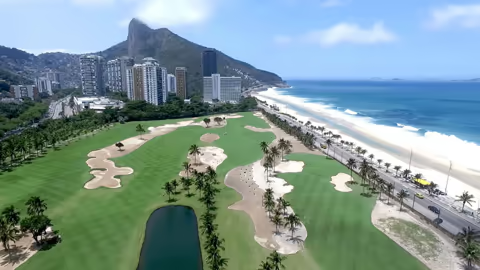
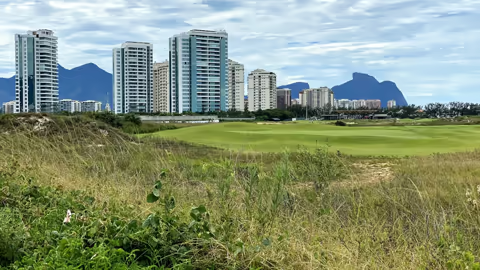
Rio de Janeiro offers a contrasting coastal and mountainous setting, where golf interacts with dramatic topography and iconic landscapes, blending urban proximity with natural preservation.
In the southern states of Paraná and Rio Grande do Sul, cooler climates and European settlement patterns have fostered courses with seasonal variation and a stronger amateur competition culture.
The northeast, particularly Bahia, represents a newer frontier where resort-oriented golf aligns with beach tourism and international travel rather than domestic club membership.
Signature courses in Brazil illustrate the sport’s adaptation to these varied contexts.
Gávea Golf & Country Club in Rio de Janeiro, originally designed by J.H.
Taylor and later refined with modern agronomy, is notable for its routing between ocean, hills, and rainforest remnants, and it has long hosted national championships that define Brazil’s competitive calendar.
São Paulo Golf Club, redesigned by Frank Pennink, carries historical significance as the country’s first formal course and continues to serve as a benchmark for traditional parkland golf adapted to tropical maintenance conditions.
Fazenda Boa Vista, designed by Randall Thompson in the interior of São Paulo state, represents contemporary Brazilian golf with wide fairways, strategic water features, and integration into a luxury residential development, hosting professional events that attract international attention.
In Bahia, the Terravista Golf Course, designed by Dan Blankenship, combines clifftop holes along the Atlantic with inland stretches, leveraging tourism-driven investment and staging South American Tour events that connect Brazil to the regional professional circuit.
Player development in Brazil has gained structure and visibility in the post-2020 period, supported by the Brazilian Golf Confederation’s emphasis on youth programs, school outreach, and international competition pathways.
Junior academies associated with major clubs have expanded access beyond traditional elite circles, and participation data released after 2020 indicates gradual increases in registered junior golfers, though comprehensive national statistics remain fragmented.
Brazil’s most internationally recognized players, such as Adilson da Silva and Alexandre Rocha, have built careers across the European and PGA Tour ecosystems, demonstrating that Brazilian golfers often succeed through international migration rather than a robust domestic professional tour.
More recently, younger players have benefited from collegiate golf in the United States, reflecting a development model that prioritizes education alongside competitive advancement.
Tourism appeal plays a growing role in Brazilian golf, even if it remains secondary to the country’s broader leisure image.
Golf travel is typically packaged with cultural and natural attractions, such as Rio de Janeiro’s urban landmarks, São Paulo’s culinary scene, or Bahia’s historic towns and beaches, positioning golf as a complementary experience rather than a primary motivator.
Peak golf seasons vary by region but generally align with the drier months from May to September in much of the country, offering favorable conditions for international visitors from Europe and North America.
Sustainability efforts have become increasingly prominent since 2020, driven by environmental regulation, public scrutiny, and operational necessity.
Courses have invested in water-efficient irrigation systems, reclaimed water usage, and grass species suited to tropical and subtropical climates, while energy-saving measures, including solar installations and reduced chemical inputs, are gradually spreading.
Wildlife corridors and native vegetation buffers are particularly relevant in regions bordering the Atlantic Forest, where biodiversity protection intersects directly with course management, and some clubs have pursued international environmental certifications, although adoption remains uneven.
Looking to the future, golf in Brazil is characterized by cautious optimism rather than expansionist ambition.
Planned projects focus primarily on upgrading existing facilities, improving accessibility, and enhancing youth development rather than building large numbers of new courses, reflecting land constraints and shifting real estate priorities.
Discussions around hosting higher-profile international tournaments continue, supported by Brazil’s experience with major sporting events, but growth forecasts emphasize consolidation, sustainability, and cultural integration, suggesting that Brazilian golf’s identity will continue to be shaped by its urban concentration, immigrant heritage, and adaptation to tropical realities rather than mass-market expansion..